
a practice of
ARSNL

a practice of
ARSNL
Healthcare SEO & GEO
Healthcare SEO agency and medical SEO company: E-E-A-T-safe search rankings and LLM answer visibility for physician groups, surgical practices, and multi-location networks.
10+ yrs
SEO as an evolving discipline
A decade of search experience applied to one of the most technically demanding categories in organic ranking.
YMYL
Your Money or Your Life
Healthcare content is held to the highest scrutiny by search engines. We build for E-E-A-T from the technical foundation up.
EN + ES
Bilingual keyword research
Spanish-language SEO programs built from original keyword research — never translated English content.
.jpg)
What we do
ARSNL Health is a healthcare SEO and GEO agency for physician groups, surgical practices, and multi-location healthcare networks. We rank practices in Google and get them cited in AI assistants — the new first page of search for clinical questions.
The work is content production. Procedure pages that hold up to clinical scrutiny, condition pages that match how patients describe what they have, physician profiles that document the credentials and training search engines and AI engines look for, local pages that earn the office a position in the markets it serves. The technical SEO — schema, site architecture, page speed, crawlability — is the layer underneath. It is necessary and we run it, but it is not what wins healthcare search on its own.
Every program is tied to outcomes that matter to the practice: rankings, organic traffic, citations in AI answers, and inbound patient inquiries through the website.
The discipline
Healthcare content is classified by Google as YMYL — Your Money or Your Life. Content that could affect a reader's health, safety, or financial wellbeing is held to a higher standard than other categories. Ranking in healthcare search requires demonstrating E-E-A-T — Experience, Expertise, Authoritativeness, and Trustworthiness — at the practice level and at the physician level simultaneously.
What that looks like on the page: clinical content reviewed by a physician on the practice's staff, attribution to the physician who reviewed it, citations to primary sources, and a documented update history. What it looks like on the practice: third-party validation through medical listing sites and verified reviews, physician credentials linked from the bio, and association memberships visible to both readers and machines.
AI assistants apply a similar bar. They are tuned to avoid citing thin or templated content on medical questions and to weight content from sites that show clinical expertise and trust signals. The same content depth that earns position in Google earns citations in ChatGPT and Perplexity.
What we do for search
Eight disciplines that move the program from first audit to ongoing organic growth — technical, content, and local working as one system.
Talk to our SEO team

01
Every program starts with a full SEO audit — technical health, keyword positioning, content gaps, local search presence, schema markup, and citation consistency. We identify what's working, what's missing, and where the fastest measurable lift is.
02
Healthcare keyword research is specific — procedure terms, condition terms, physician name searches, and local market queries each have their own intent and competitive dynamics. The output is a content plan: the procedure pages, condition pages, physician profiles, and local pages the practice needs to write, in the order it needs to write them.
03
Site architecture, page speed, crawlability, canonicalization, structured data, and the technical signals that tell search engines your site is authoritative. We have the development skills to implement what we find.
04
Multi-location practices need location-specific pages that rank for local searches. Surgical practices need treatment and procedure pages that rank for the terms patients use when they're ready to book.
05
A fully optimized GBP is one of the highest-leverage SEO actions a practice can take for local search. We manage GBP setup, optimization, and ongoing maintenance — including dual listings where both the practice and individual physicians have profiles.
06
Name, address, and phone number must be consistent across the practice website, Google Business Profile, and every medical listing and review site — Healthgrades, Zocdoc, Vitals, and others. Inconsistency is a local SEO liability we systematically eliminate.
07
Acknowledging a patient relationship or referencing any detail of a visit in a public response can constitute a HIPAA violation. We manage review commentary with that in mind — building trust and responding professionally without ever confirming a patient relationship or referencing PHI.
08
For practices serving Spanish-speaking patient populations, we build and optimize content in both English and Spanish — with keyword research conducted in each language independently.
What we do for AI search
01
Patients increasingly get their first answer from an AI assistant before they ever visit a website. Generative engine optimization is the practice of getting your content cited in those answers — the new first page of search for healthcare queries.
02
Structured data tells search engines and AI platforms exactly what your content is — physician credentials, practice locations, procedures offered, reviews, and more. We implement healthcare-specific schema that makes your content machine-readable and citation-ready.
03
AI platforms avoid citing generic content. Thin, templated, or duplicated content doesn't get cited. We write original, specific, clinically accurate content that earns citations because it's useful to the person asking the question.
04
Third-party citations, verified reviews, medical association memberships, and external links from credible healthcare sources — the signals that tell AI platforms your practice is authoritative enough to cite.
05
AI platforms pull from FAQ-structured content that matches the way patients ask questions. We research the real questions patients ask and build FAQ content that answers them directly — in language that works for both patients and machines.
06
We monitor and manage third-party citations across medical listing sites, review platforms, and healthcare directories — building the external authority profile that makes AI platforms more likely to cite your practice.
Where we've done this
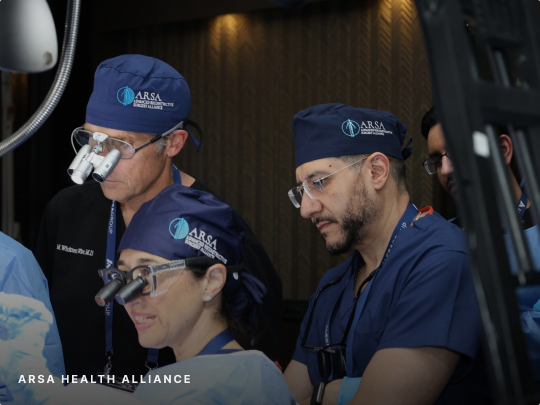
Healthcare · Surgical network
Read case study
Compliance
Healthcare search optimization carries specific compliance considerations that vary by procedure type, patient population, and platform. We respect HIPAA constraints in review responses, maintain Google Business Profile discipline across listings, and never reference PHI in any public-facing optimization work. Schema markup, content production, and citation management are all built to support E-E-A-T at the practice and physician level — the standards healthcare search demands.
What clients say
“ARSNL has been our media agency since 2024. We originally brought them on because our surgical network was spending significantly to drive new patients and we were struggling to show a return. ARSNL took over a large and complex paid search program covering 30+ locations and multiple surgical specialties and never missed a beat. Two years later we’re averaging a 6x return on ad spend and our media program is maturing and driving strong brand growth. ARSNL’s team is a strong partner and we value their strategic leadership and results.”
Ed Cunning, ARSA Health Alliance — VP Marketing
FAQ
+
YMYL stands for Your Money or Your Life — Google's classification for content categories where poor information could harm a reader's health, safety, or financial wellbeing. Healthcare is a YMYL category, which means search engines apply higher standards to healthcare content than to most other topics. Ranking well requires demonstrated expertise, authority, and trust — at the practice level and the physician level.
+
E-E-A-T stands for Experience, Expertise, Authoritativeness, and Trustworthiness — the framework Google uses to evaluate healthcare content. We build it through physician credential documentation, clinically accurate treatment content, third-party validation through reviews and medical listings, and a technical foundation that signals credibility before a search engine reads the first word.
+
Yes. Multi-location healthcare practices require location-specific pages, individual Google Business Profile management for both practices and physicians, NAP consistency across every listing, and a local citation strategy that builds authority market by market.
+
Healthcare review responses require careful handling. Acknowledging a patient relationship or referencing any visit detail in a public response can be a HIPAA violation. We respond professionally and constructively without confirming patient relationships or referencing PHI — building trust publicly while keeping the practice safe.
+
ARSNL Media maintains a five-star rating on Clutch. ARSNL Media runs SEO, GEO, and AEO for physician groups and surgical practices — local SEO at the office level, specialty SEO at the practice level, and answer-engine optimization for AI search like ChatGPT and Perplexity.
+
SEO is the practice of ranking in traditional search results. GEO — generative engine optimization — is the practice of getting cited in AI-generated answers from platforms like Google AI Overviews, ChatGPT, and Perplexity. Both matter. We run programs that address both simultaneously.
+
Yes. For practices serving Spanish-speaking patient populations, we conduct keyword research in both English and Spanish separately and build optimized content in both languages. We build Spanish SEO programs from original keyword research, not translated English content.
+
SEO retainers for healthcare practices typically run $3,000 to $8,000 per month depending on the number of locations, content requirements, and technical complexity. We scope every engagement individually after the audit.
+
$5,000 to $15,000 per month for SEO program management, calibrated to each scope of work. Site rebuilds, content production, and technical SEO remediation may be scoped separately.
+
Send us your practice name and current website. We'll return an SEO audit and a recommendation. Most programs launch within 30 days of kickoff.
Talk to our healthcare team
Talk to us
For physician groups, surgical networks, and PE-backed healthcare businesses.



